Stacy Ford discusses practical considerations in relation to AI with KWM’s Chief Innovation Officer, Michelle Mahoney. Read on for the latest in KWM’s inhouse-centred series: From our inhouse to yours.
For in-house lawyers, Artificial Intelligence (AI) is rapidly becoming a practical tool to enhance efficiency, draw out legal risk, and deliver strategic value. Yet, as with any innovation, its adoption requires careful consideration.
I recently spoke with Michelle Mahoney, KWM’s Chief Innovation Officer, who is at the forefront of legal technology innovation and transformation. Michelle shared her perspective on how AI is being deployed by in-house legal teams, how to measure impact, hurdles for adoption, and what is around the corner.
Michelle is clear: AI is not about replacing in-house lawyers but augmenting them. AI today can take away repetitive, low-value tasks and free up lawyers to focus on strategic, high-value work.
Top three use cases for in-house lawyers
When asked about the most impactful AI use cases for in-house lawyers, Michelle identified three clear frontrunners:
- Playbooks: AI can help build contract negotiation playbooks with standard and fallback positions, enabling in-house lawyers and business stakeholders to negotiate contracts more efficiently.
- Contract review and clause extraction: AI can rapidly review documents and extract key clauses, expediting the analysis of positions across large collections of documentation.
- Summaries: AI can condense complex and lengthy legal documents into summaries for legal analysis.
Michelle explained that contracts are a great opportunity for using AI, as they are, lengthy, unstructured data, and have a combination of data that is both critical and necessary. She said that AI tools are getting better at identifying and surfacing what in-house lawyers deeply care about in contracts.
For other AI use cases, please see our article Making sense of AI – a practical approach.
Measuring impact
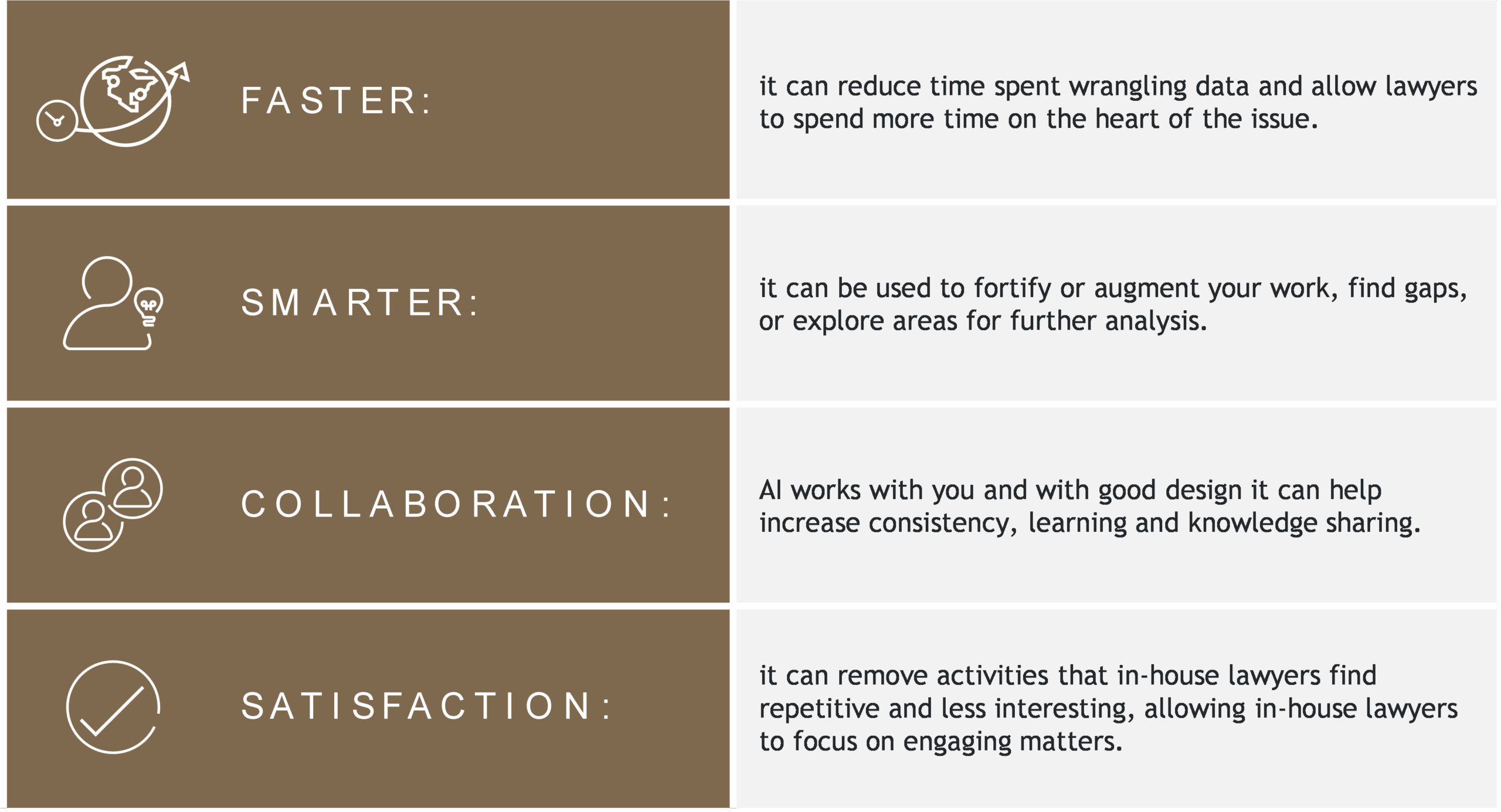
When considering how to measure the impact of AI on legal workflow, most people jump to measuring value in terms of time savings. However, Michelle notes that using a time-only metric will not capture the full value that an in-house legal team will experience.
AI’s impact on in-house legal teams is hugely variable depending on the use case. Measurements should also extend to quality, consistency and even to job satisfaction. The below table outlines some of the benefits of AI and areas that can be considered when measuring impact.
Adoption hurdles
I asked Michelle what she saw as the biggest adoption hurdles and for some tips to overcomes those hurdles.
Michelle describes Gen AI as a ‘participatory sport’ as everyone needs to be using it. She explained that it takes time to build capability and requires perseverance to work through issues. You will need to find time to test and learn, and to refine results when they are not what you had in mind.

AI hallucinations can be very elegant; you need to validate and critically assess everything that is generated. The output known as ‘AI slop’ requires a critical eye and active review.
Michelle says that ‘we [lawyers] are in the precision business and foundational AI models are not precision tools’. AI tools are great at looking for gaps and being creative, but their accuracy needs to be checked.

Embedding AI
At KWM the development of an AI strategy covering AI governance, responsible use and adoption of AI tools has been pivotal to embedding AI at KWM. This has included:
- Policy development: the development of an AI policy framework setting out the responsible use of AI.
- Training: training staff on the use of AI tools, including core platform features, prompt engineering, limitations, and professional obligations.
- Guidance: providing continuing guidance on AI through a dedicated intranet site, guidelines, Q&A sessions, and communicating updates.
- Micro-credentialing: credentialling KWM staff in AI through KWM’s digital literacy programs: Legal Transformation Belts and LegalTech Belts.
The deployment of Harvey AI, an AI tool designed specifically for law firms and legal teams, in May 2025 following robust experimentation represented a significant milestone in KWM’s AI journey.
Through the development of a robust AI strategy and deployment of cutting-edge AI tools, Michelle says that ‘there has been really high adoption of AI at KWM. For example, 93% of our legal staff are trained in and are accessing Harvey AI’.
What to watch out for over the next 12-24 months
So then, what should in-house lawyers expect over the next 12-24 months and what attributes are required to stay ahead?
- Emerging AI capabilities: Michelle explained that prompts will start to combine and lead a user through a series of steps. She said that the flows, if well designed will guide users through an experience that asks questions, uploads documents, provides teachable moments, and reduces the prompting need for a repeatable activity. These processes will be packaged as a series of steps to get to outcomes known as agentic workflows.
- Attributes required: Michelle stressed that curiosity will be critical to engaging with AI technologies as they evolve. She said that ‘we are all on the AI rollercoaster and there is no getting off – it will require lifelong learning – which requires you to remain curious’. Remaining vigilant is also critical, particularly in relation to what you are asking AI and what it is generating for you.
Michelle also explained that in-house legal teams should now be focusing on document collection, data governance, and identifying high-repetition activities that can be systemised using agentic workflows.
Further information
If you need further guidance on AI in your in-house legal team, please reach out to Kendra Fouracre or Cheng Lim.
Check out other insights from the Office of General Counsel team here and subscribe to KWM Pulse using the button below to stay across upcoming articles in areas of interest.